
Nimi Jātaka
Nimi Jātaka
In the prosperous kingdom of Mithila, there once reigned a king named Nimi, a ruler whose virtue and righteousness were spoken of throughout the land. King Nimi was known for his unwavering adherence to the five precepts of morality, and his kingdom was a beacon of peace and justice. Yet, despite his immense virtue, King Nimi held a secret desire: to witness the celestial realms and the rewards that awaited the truly virtuous in the afterlife.
One day, as King Nimi meditated upon his deepest wish, the god Sakka, lord of the Tavatimsa heaven, heard his earnest plea. Moved by the king's pure heart and his dedication to righteous living, Sakka decided to grant his wish. He sent his celestial charioteer, Matali, to escort the king on a journey beyond the mortal world.
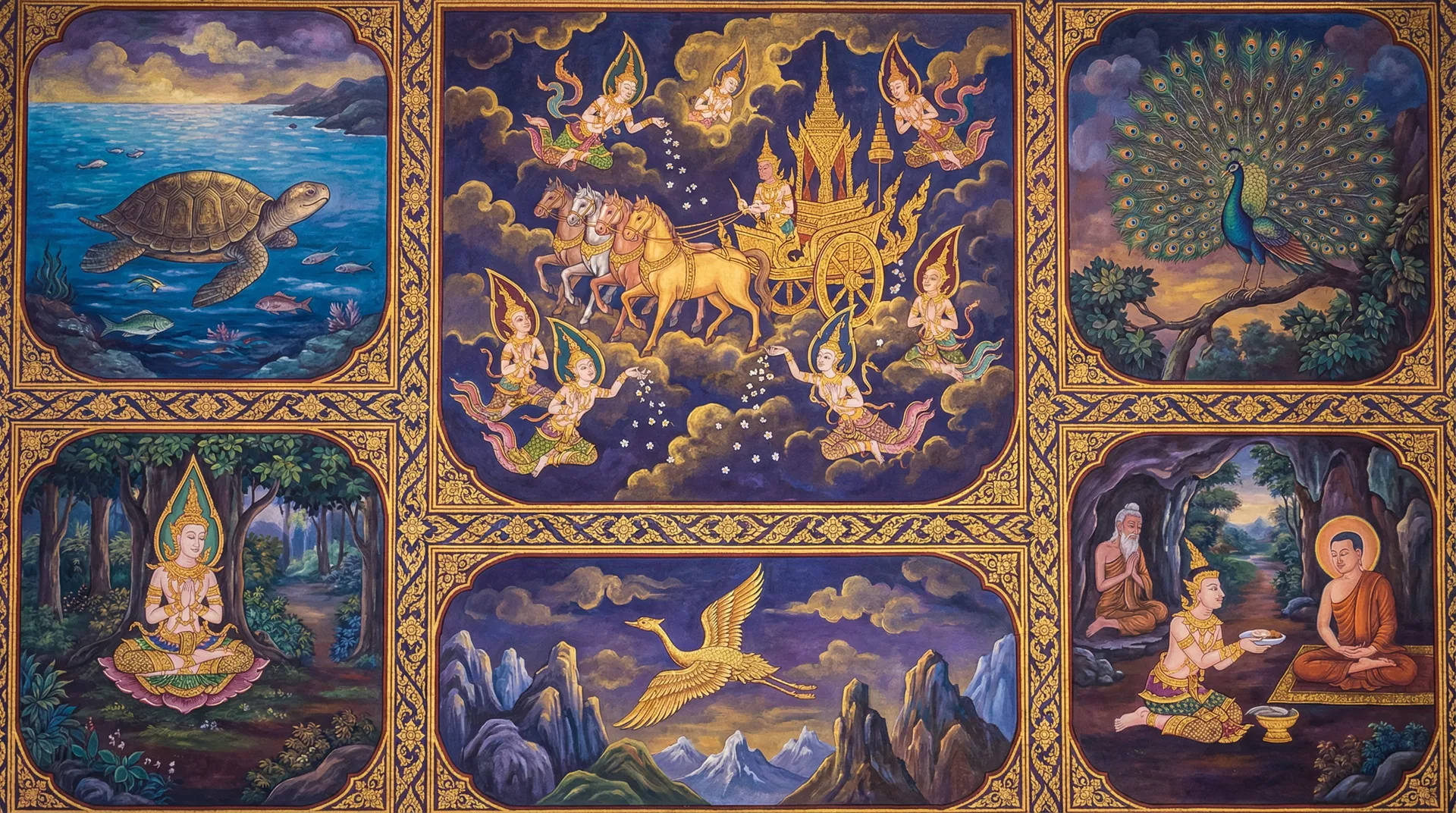
Matali descended to Mithila in his magnificent chariot, its wheels humming with celestial energy. He appeared before King Nimi, his form radiant and awe-inspiring. 'O King Nimi,' Matali announced, his voice like the chime of heavenly bells, 'I have been sent by the great Sakka to bring you on a journey of unparalleled wonder. Prepare yourself to visit the realms of the gods.'
King Nimi, his heart pounding with a mixture of awe and anticipation, readily agreed. He bid farewell to his queen and his ministers, entrusting them with the care of his kingdom, and mounted the celestial chariot. As they ascended, the earthly kingdom of Mithila shrunk beneath them, replaced by the vast expanse of the cosmos.
Their journey took them first to the Tavatimsa heaven, a realm of breathtaking beauty and splendor. Matali guided the king through the celestial palaces, introducing him to the gods and goddesses who resided there. King Nimi witnessed firsthand the fruits of their good deeds, the divine pleasures and eternal bliss they enjoyed as a reward for their virtuous lives. He saw beings adorned in heavenly garments, surrounded by celestial music and fragrant flowers, their faces radiating contentment.
However, Sakka did not stop there. He wished for King Nimi to understand the full spectrum of karmic consequences. He then guided the king to witness the realms of suffering, the hells where beings endured immense torment as a result of their wicked deeds. King Nimi saw creatures writhing in agonizing pain, subjected to unimaginable tortures, a stark and horrifying contrast to the heavenly realms.
The sight was deeply disturbing to King Nimi. He witnessed beings being boiled in cauldrons, impaled on spears, and subjected to endless cycles of pain. He saw the faces of the tormented, their cries echoing through the desolate landscapes. It was a grim testament to the law of karma, where every action, good or bad, bore its inevitable consequence.
After witnessing these realms, King Nimi was brought back to the Tavatimsa heaven. Sakka then addressed the king, his voice filled with wisdom. 'O King Nimi,' Sakka said, 'you have seen the rewards of virtue and the punishments of vice. You have witnessed the unfolding of karma. Now, I implore you, return to your kingdom and rule with even greater righteousness. Let these visions inspire you to live a life that ensures your place among us.'
Upon his return to Mithila, King Nimi was a changed man. The celestial journey had profoundly impacted him. He no longer ruled solely out of duty, but with a deep, personal understanding of the consequences of actions. He redoubled his efforts to uphold justice, to practice generosity, and to inspire his people to live virtuous lives. He often recounted his experiences, describing the beauty of the heavens and the horrors of the hells, using these vivid accounts to motivate his subjects towards righteous conduct.
King Nimi's reign became even more renowned for its justice and virtue. He not only ensured peace and prosperity in his earthly kingdom but also laid the foundation for his own future well-being in the realms beyond. His journey was a testament to the power of seeing, of understanding, and of integrating that knowledge into a life of unwavering ethical commitment.
— In-Article Ad —
💡Moral of the Story
The law of karma is absolute: virtuous deeds lead to heavenly rewards, while wicked deeds result in suffering. Understanding these consequences should inspire us to live a life of unwavering righteousness and compassion.
Perfection: Wisdom (Prajna), Virtue (Sila), Conviction (Adhitthana)
— Ad Space (728x90) —
More Jataka Tales You May Enjoy
 211Dukanipāta
Khaggavisana Jataka
The Horned Solitary OneIn the ancient city of Mithila, nestled amidst lush gardens and bustling mark...
💡 True happiness and peace are found through inner cultivation, detachment from worldly desires, and self-reliance, much like a solitary rhinoceros finds strength in its own horn.
 48Ekanipāta
The Bodhisatta as the Generous King
The Bodhisatta as the Generous KingIn the ancient and prosperous kingdom of Varanasi, ruled a king n...
💡 True generosity is not deterred by pride or rejection; it finds ways to benefit all, demonstrating the highest form of leadership.
 400Sattakanipāta
Mahosadha Jataka
Mahosadha JatakaIn the ancient kingdom of Mithila, a city famed for its wise ruler, King Vedeha, the...
💡 Exceptional intelligence, when coupled with foresight, justice, and compassion, is the greatest asset for ensuring the well-being, prosperity, and peace of a kingdom and its people.
55EkanipātaThe Bodhisatta as the Young Brahmin
The Bodhisatta as the Young BrahminIn the ancient city of Ujjain, a place of profound spiritual lear...
💡 Selfless service and pure compassion, born from a heart devoted to alleviating suffering, can overcome even the greatest adversities and reveal the divine within.
58EkanipātaThe Great Ocean Jataka
In a land of bountiful shores, where the vast sea met fertile lands, there lay a small fishing villa...
💡 True wealth is found in generosity and compassion, not in material possessions. Greed blinds the mind and leads to self-destruction.
71EkanipātaThe Jataka of the Clenched Fist
In a time long past, in the prosperous city of Varanasi, the Bodhisatta was born as a young Brahmin ...
💡 True leadership lies in protecting the vulnerable, even at great personal risk.
— Multiplex Ad —